
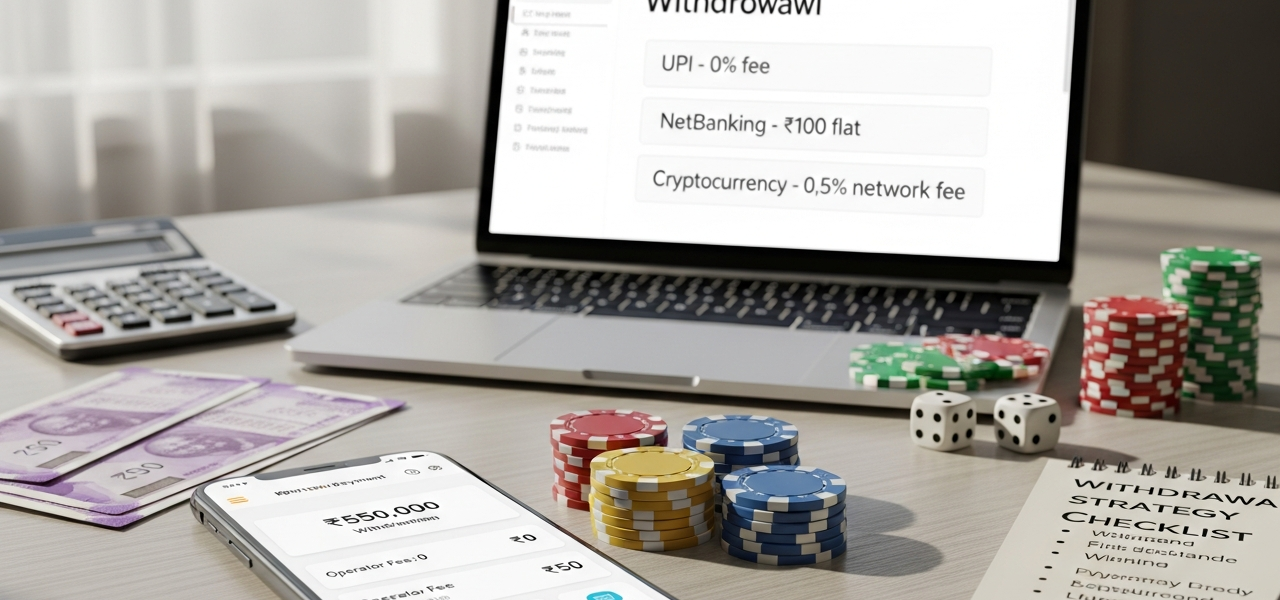
Understanding Withdrawal Fees On Gambling Platforms
As Indian players increasingly turn to online casinos and betting apps for entertainment, the thrill of winning can quickly fade when withdrawal delays or unexpected fees eat into profits. While generous bonuses and competitive odds attract new users, understanding how money actually leaves your account is equally critical. Withdrawal fees aren’t just about the operator’s cut—banks, payment processors, and e-wallets all play a role in determining how much you ultimately receive. This guide clarifies how withdrawal costs work across Indian gambling platforms, explains the fees charged by both operators and external providers, and provides actionable strategies to minimize expenses when cashing out your winnings.
The goal of this article is to demystify withdrawal fees specific to Indian players, covering local payment methods like UPI and NetBanking, identifying hidden charges buried in terms and conditions, and showing you how to choose platforms that maximize your net payout. Whether you’re using offshore sites or domestic operators, consolidating withdrawals or exploring cryptocurrency options, this comprehensive guide bridges the gap between marketing claims of “instant, fee-free withdrawals” and the financial reality of moving money back to your bank account.
How Withdrawal Fees Work on Indian Gambling Platforms
Withdrawal fees and limits are fundamental to how gambling platforms manage cash flow and comply with payment regulations. Many Indian betting sites advertise “zero withdrawal fees,” but this claim often masks the full cost picture. The operator may charge nothing, yet your bank, e-wallet, or payment processor may still deduct a percentage or fixed amount from your requested withdrawal. Understanding the distinction between these layers—and where each charge originates—is essential to calculating your true net payout.
Fees operate in two primary forms: percentage-based (typically 1–7.5% depending on method and provider) and fixed fees (flat amounts like ₹50–₹500). A simple example illustrates the impact. If you request a ₹10,000 withdrawal and your chosen method attracts a 2% operator fee plus a ₹100 bank charge, your net receipt drops to ₹9,800. Over multiple withdrawals, these costs compound. Additionally, some platforms impose fees only on certain methods or during peak hours, and many sites hide these charges in detailed terms and conditions, revealing them only at the cashout step.
Withdrawal Fees vs Minimum Withdrawal Amount
A frequent point of confusion is the difference between withdrawal fees and minimum withdrawal amounts. Platforms do not charge fees simply for meeting a minimum—rather, they set a lowest threshold (often ₹500 or ₹1,000) below which withdrawals cannot be processed at all. This threshold protects operators from processing cost overhead on tiny transactions. Fees, by contrast, are deducted from your requested amount once you meet this minimum.
For example, if a site’s minimum withdrawal is ₹1,000 and you request exactly ₹1,000 with a 2% processor fee, you’ll receive ₹980. The fee is subtracted from your balance before payout. Conversely, if you try to withdraw ₹500, the system will reject your request entirely because it falls below the minimum—not because of a fee, but because the platform won’t process transactions below that threshold. Always check both the minimum withdrawal amount and the applicable fee schedule for your chosen payment method.
Who Charges What: Operator vs Payment Provider
The most reputable betting sites operating in regulated markets do not charge withdrawal fees themselves. Instead, costs come from third-party payment processors: your bank, UPI provider, e-wallet company, or cryptocurrency exchange. When you see a “₹0 withdrawal fee” claim, the operator is telling the truth—they’re not taking a cut. However, your bank might charge ₹50–₹200 for processing a domestic transfer, or your UPI provider might apply a 1% surcharge on outbound gambling transactions.
The solution is to check your chosen platform’s banking page for a list of supported methods and any operator-side fees, then cross-reference the external provider’s fee schedule. Most Indian banks and UPI systems publish their charges publicly. Skrill and Neteller, popular e-wallets on international sites, often charge 1–2% on gambling withdrawals. Cryptocurrency exchanges frequently levy 0.5–1% network fees for Bitcoin or Ethereum transfers. By knowing both sides of the equation, you can select the method that minimizes your total cost.
Typical Withdrawal Fees by Payment Method in India
| Payment Method | Common Use on Indian Sites | Typical Operator Fee | Typical Processor Fee / Range | Usual Processing Time | Best Use Case |
|---|---|---|---|---|---|
| UPI (Google Pay, PhonePe, Paytm) | Very common on domestic & offshore sites | 0% | 0–1% (sometimes flat ₹20–50) | 5 minutes – 2 hours | Small to medium withdrawals; fastest local option |
| Debit Card | Standard on most platforms | 0–1% | 1–3% (issuing bank dependent) | 1–3 business days | Medium withdrawals; familiar to most players |
| NetBanking | Increasingly popular on Indian sites | 0% | 0–1.5% (bank dependent) | 2–4 hours | Direct bank account transfers; transparent fees |
| Local Bank Transfer (NEFT/IMPS) | Widely supported on regulated sites | 0% | ₹0–200 flat (bank dependent) | 30 minutes – 1 hour (IMPS) / 2–4 hours (NEFT) | Large withdrawals; lowest per-transaction cost |
| E-wallets (Skrill, Neteller) | Common on offshore platforms | 0–2% | 2–5% (wallet provider + bank) | 1–3 business days | International payouts; secondary fallback |
| PayPal | Limited on gambling sites; more common internationally | 1–3% | 2–4% (PayPal + receiving bank) | 2–3 business days | Rare for Indian gambling; better for international players |
| Cryptocurrency (BTC, USDT, ETH) | Growing on offshore & crypto-friendly sites | 0–1% | 0.5–2% (network fee + exchange) | 10 minutes – 1 hour | Tech-savvy players; no KYC dependency; volatile conversion |
India-Focused Methods: UPI, NetBanking and Local Bank Transfers
UPI has revolutionized Indian gambling withdrawals by offering near-instant transfers with minimal fees. Most major UPI providers (Google Pay, PhonePe, Paytm) charge nothing or a tiny flat fee (₹20–50) per transaction, making it ideal for frequent small withdrawals. However, offshore sites sometimes route UPI through intermediaries or “mule” accounts, which can introduce compliance risks or hidden markups. Domestic regulated platforms typically offer direct UPI integration, ensuring transparency and speed.
NetBanking and local bank transfers (NEFT/IMPS) dominate for larger payouts because they offer fee certainty and direct bank-to-bank settlement. Most Indian banks charge ₹0–200 flat fees for domestic transfers, far cheaper than percentage-based methods for amounts over ₹5,000. IMPS is faster (30 minutes to 1 hour) but slightly pricier than NEFT (2–4 hours); the trade-off depends on your urgency. For consistent, cost-effective withdrawals, using the same payment method for both deposits and withdrawals often triggers operator discounts or fee waivers, a strategy worth exploring on your chosen platform’s terms.
Instant Withdrawal Betting Sites vs Standard Platforms
- Broader local payment integration: Instant withdrawal sites prioritize UPI, NetBanking, and e-wallets over traditional cards, reducing processing times and costs.
- Transparent, upfront fee disclosure: Most fast-payout platforms display applicable fees before you confirm withdrawal, avoiding surprises.
- Lower per-transaction operator fees: Many instant sites charge 0% operator fees, relying on processor charges alone, which are often lower than platform markups.
- Realistic processing times with guarantees: Rather than vague “1–5 business days,” instant sites commit to specific timelines (e.g., “UPI within 10 minutes”) or offer refund guarantees if delays occur.
- Responsive withdrawal support: Live chat and dedicated banking teams help troubleshoot failed or delayed payouts, reducing customer frustration.
- Restricted withdrawal limits on fast methods: To manage fraud and liquidity, some instant sites cap UPI payouts at ₹1–5 lakh per transaction, requiring multiple withdrawals for large sums.
- Potential higher fees on alternative methods: If you can’t use UPI due to account limits or restrictions, fallback methods may carry steeper fees or longer processing times.
Key Features of Fast Withdrawal Betting Apps in India
- Same-day or next-day settlement: Fast apps leverage UPI, e-wallets, and NetBanking to deliver payouts within hours, not days, matching customer expectations in a digital-first market.
- Multi-method flexibility: Offering 5+ payment options (UPI, NetBanking, wallets, crypto) ensures players can choose the lowest-cost method for their withdrawal size and timeline.
- Zero or minimal operator-side fees: Players only pay processor fees, not platform markups, aligning incentives and building trust.
- Automated KYC and instant account verification: Streamlined document verification (Aadhaar, PAN, selfie) means players reach full withdrawal limits faster, without admin delays.
- Withdrawal limit tiers tied to account age and verification: Rather than locking players into low caps indefinitely, fast apps progressively increase limits as trust and compliance data accumulate.
Trade-Offs: Speed vs Cost and Limits
Speed and cost are inversely related on many platforms. UPI offers the fastest withdrawals but may be capped at ₹1–2 lakh per transaction, forcing large winners to split payments across multiple days. Bank transfers are slower (2–4 hours) but typically allow higher single-transaction limits (₹5–10 lakh or more), reducing the effective cost per rupee for large payouts. Offshore sites using international e-wallets (Skrill, PayPal) may process withdrawals within 24 hours but charge 2–4% fees, whereas domestic alternatives with longer timelines often charge less.
Additionally, offshore platforms offering “instant UPI withdrawals” often route money through intermediary accounts held by individuals or businesses, not the operator directly. While marketed as instant and fee-free, these systems carry compliance risks—your bank may flag unusual inflows, your account could be frozen if the intermediary is identified as engaged in mule activity, and reporting for tax purposes becomes complex. Weighing convenience against regulatory exposure is crucial; domestic platforms offer less speed but greater legal clarity.
Withdrawal Limits, KYC Tiers and Their Impact on Fees
| Account Verification Level | Typical Weekly Withdrawal Cap | Extra Checks Required | Likelihood of Extra Fees | Player Profile (India context) |
|---|---|---|---|---|
| Unverified (email/phone only) | ₹5,000–₹10,000 | None initially | Low | New casual players testing the platform |
| Basic KYC (Aadhaar + selfie) | ₹25,000–₹50,000 | Quick document snapshot | Low | Most regular domestic bettors |
| Full KYC (Aadhaar, PAN, address, selfie) | ₹1–5 lakh+ | Complete identity verification, possible bank account details | Very low | Serious players, winners, high-volume bettors |
| VIP/Premium tier (bank statement, income proof, etc.) | ₹5+ lakh (unlimited tier available) | Enhanced due diligence, source of funds verification | Minimal to none (sometimes fee waivers) | High-value players, frequent large withdrawals |
How KYC and Compliance Affect Indian Players
Know Your Customer (KYC) verification is not merely a bureaucratic hurdle—it directly impacts your withdrawal capacity and associated costs. Unverified accounts face strict weekly limits (₹5,000–₹10,000), forcing frequent small withdrawals that incur multiple per-transaction fees. A ₹5,000 withdrawal with a ₹100 bank fee costs you 2%, whereas consolidating to ₹50,000 after full KYC reduces the effective cost to 0.2% on the same fee.
For Indian players on both domestic and offshore platforms, completing KYC early is financially prudent. Domestic regulated sites require basic Aadhaar and PAN verification, which most adult Indians can complete in minutes via selfie verification. Offshore platforms vary—some accept Indian documents seamlessly, others demand additional proof of address or source of funds, especially for large payouts. Delays in KYC verification often correlate with withdrawal holds or additional scrutiny fees (informal delays disguised as “compliance checks”). By proactively submitting complete documentation, you unlock higher limits and avoid surprise processing delays that effectively inflate your withdrawal cost.
Bonus Terms, Wagering Requirements and Hidden Withdrawal Costs
- Unmet wagering requirements lock funds: If you claim a ₹10,000 bonus with a 30× wagering requirement and attempt to withdraw before accumulating ₹300,000 in total bets, the bonus (and often associated winnings) is forfeited, effectively costing you the full amount.
- Maximum bet restrictions void bonuses on breach: Many bonus terms restrict per-bet maximums (e.g., ₹200 per bet). Exceeding this limit voids the bonus and, on some platforms, associated winnings—a hidden penalty masquerading as an account rule.
- Bonus expiry dates force rushed decisions: Bonuses typically expire after 7–30 days. If you can’t complete wagering in time, your bonus disappears, and you may forfeit accumulated winnings tied to bonus play.
- Certain game categories don’t contribute to wagering: Slots might count 100% toward wagering, but table games only 50%, and live casino games sometimes 0%. Misunderstanding this can leave you short of requirements and unable to withdraw.
- Withdrawal limits during bonus play are reduced: While a bonus is active, your maximum withdrawal might drop from ₹5 lakh to ₹50,000, forcing you to either wait for the bonus expiry or leave funds on the platform.
- No-withdrawal clauses until bonus is forfeited: Some aggressive operators forbid withdrawals entirely until the bonus is either completed or explicitly declined, trapping your funds temporarily.
- Bonus abuse penalties and account suspension: Exploiting bonus loopholes (rapid deposits and withdrawals, bonus stacking across accounts, collusion) can trigger account suspension and fund forfeiture, the costliest hidden penalty.
Common Bonus-Related Pitfalls Before Withdrawal
- Claiming bonuses without reading T&Cs: Many players accept a bonus and assume it’s “free money,” overlooking 30× wagering or game restrictions. After losing the bonus wagering race, they discover funds are locked.
- Playing restricted games with bonus funds: Betting on excluded categories (e.g., blackjack with a slots-only bonus) at full stake while bonus is active can void the bonus and associated winnings instantly.
- Withdrawing partially before bonus completion: Attempting to withdraw cash while bonus funds remain can trigger automatic bonus forfeiture, leaving you with a lower net balance than expected.
- Ignoring bonus expiry timers: Bonuses that expire before wagering is met are automatically forfeited, and residual winnings may be clawed back depending on platform terms.
- Stacking bonuses across accounts to bypass limits: Creating multiple accounts to claim duplicate bonuses is a common violation; when detected (via payment method or IP address), all accounts are suspended and balances confiscated.
- Not checking bonus eligibility for your payment method: Some bonuses apply only to certain deposit methods (e.g., card deposits only, excluding crypto or e-wallets), creating surprise ineligibility at withdrawal time.
Practical Checklist Before Requesting a Withdrawal
Before submitting a withdrawal request, verify the following: Bonus Status: Confirm that all bonus funds have been either completed (wagering requirement met) or explicitly forfeited. Check your account dashboard for any active bonus timer or pending wagering amount. Cash vs Bonus Balance: Ensure you’re withdrawing from your cash balance, not bonus funds. Most platforms clearly label “Cash Balance” and “Bonus Balance” separately. Payment Method Compatibility: Verify that your chosen withdrawal method is available in your region and is compatible with your current withdrawal amount (some methods have per-transaction minimums or maximums). External Fee Schedule: Before confirming, review the processor’s current fee schedule—banks and e-wallets sometimes adjust rates seasonally or for promotional periods. Account Verification Status: Confirm your KYC tier supports your withdrawal amount. If you’re hitting limits, check if you can upgrade your verification level instantly to unlock higher thresholds. Processing Time Expectations: Note the estimated delivery window for your chosen method and plan accordingly. If urgent funds are needed, select faster methods (UPI, IMPS) even if fees are slightly higher.
Comparing Operator Withdrawal Policies: Low Fees vs Hidden Charges
| Policy Type | How It Works | Pros for Player | Cons / Risks | What Indian Bettors Should Look For |
|---|---|---|---|---|
| Fee-Free Model (0% operator fee) | Operator absorbs all cost; player pays only external processor fees | Transparent total cost; incentivizes large payouts; trust-building | External fees still apply; operator may offset by restrictive withdrawal limits or slow processing | Sites that clearly itemize processor fees upfront and honor limits matching competitors. |
| Percentage-Based Fees (1–3%) | Operator charges a percentage of withdrawal amount; stacks on top of processor fees | Scales fairly for large withdrawals (percentage remains constant) | Disproportionately hurts small payouts; combined with processor fees, total cost can exceed 5–6%. | Compare percentage rates across platforms; avoid if percentage exceeds 2% on your typical withdrawal size. |
| Tiered Fee Structure (lower % for larger amounts) | Fees decrease as withdrawal amount increases (e.g., 2% on ₹1–10k, 1% on ₹10–50k, 0.5% on ₹50k+) | Encourages consolidation; rewards high-value players; aligns incentives | Complex to calculate; can incentivize keeping funds on platform awaiting larger cashouts. | Ideal for frequent players cashing out ₹50k+. Compare break-even points across sites. |
| Fixed Fee Model (₹100–500 flat) | Single flat charge per withdrawal, regardless of amount | Cheaper for large withdrawals; predictable cost; simplicity | Expensive for small amounts (₹1–5k withdrawals); encourages hoarding funds. | Best for players consistently withdrawing ₹10k+. Avoid if you take frequent small payouts. |
| Method-Specific Fees (vary by UPI, card, bank) | Each payment method has its own operator fee (e.g., 0% UPI, 1.5% cards) | Flexibility to choose lowest-cost method per withdrawal | Requires upfront research; switching methods can be inconvenient. | Document each method’s fee and plan withdrawals strategically. |
Spotting Red Flags in Withdrawal Terms & Conditions
Carefully reviewing a platform’s full terms and conditions before depositing is your best defense against hidden withdrawal costs. Red flags include vague language like “withdrawal fees may apply” without specifying amounts, admin fees buried in subsections unrelated to banking, excessive percentage fees (above 3–4% for operators, above 2–3% for standard processors), and restrictive clauses like “withdrawals only on Tuesdays” or “maximum one withdrawal per week” that force unnatural consolidation patterns.
Some platforms also hide fees in “event-specific” terms—during promotions, withdrawal fees may double, or new players may face a ₹200 “processing fee” on first payouts that isn’t mentioned in standard banking pages. Others require you to bet your entire balance (not just the deposit) before withdrawing, effectively imposing an invisible fee in the form of forced additional play. Always search T&Cs for keywords like “admin,” “processing,” “convenience,” and “event,” and cross-reference any fee-related terms against the main banking page. If the language is contradictory or unclear, contact support in writing and request a fee estimate in writing before committing funds.
Offshore Indian Gambling Platforms and Payment Flows
Many offshore gambling operators serve Indian players through layered payment systems that obscure the operator-to-player fund flow. Rather than accepting deposits and processing withdrawals directly, offshore platforms often partner with aggregators or third-party payment facilitators that accept funds on their behalf, hold balances in escrow, and route payouts through non-traditional channels. This architecture enables offshore sites to bypass Indian banking restrictions (many Indian banks refuse to transact with gambling operators) while offering competitive withdrawal speeds and costs.
The problem is opacity. When an offshore site advertises “instant UPI withdrawals,” the money often flows from the operator’s overseas account through an intermediary’s Indian bank account (held in the intermediary’s name, not the operator’s) and then to the player. This creates a mismatch between the payment instruction (operator to player) and the actual settlement (third party to player), complicating tax reporting, triggering banking scrutiny, and exposing players to account freezes if the intermediary is later identified as a mule account operator.
UPI, Mule Accounts and Traceability of Winnings
UPI transfers are instantaneous and low-cost, making them attractive for offshore withdrawals. However, offshore operators can’t accept UPI payments directly because Indian banks prohibit gambling-related transactions. Instead, they route UPI payouts through individuals or shell companies that maintain Indian bank accounts and UPI addresses. When you request a ₹50,000 withdrawal, the operator instructs its Indian facilitator to send ₹50,000 from their personal UPI account to yours. From your bank’s perspective, the transfer appears to come from an individual (the mule) rather than a company, and the memo line or transfer description might vaguely reference “recharge” or “refund” rather than “gambling winnings.”
The banking system is increasingly sophisticated at detecting these patterns. If you receive multiple inflows from different individuals via UPI, all labeled vaguely or with no memo, your bank may flag the account for suspicious activity. In worst-case scenarios, your account is frozen pending investigation, and you’re asked to provide proof that the inflows are legitimate gambling winnings rather than money laundering. This administrative hassle—requiring you to retrieve old betting slips, chat logs, and account statements as evidence—is an invisible cost of offshore mule-based systems. Documenting your gambling account, betting history, and withdrawal requests meticulously protects you but adds friction.
Compliance, Tax and Banking Relationship Considerations
Large, unexplained inflows can damage your banking relationship. Indian banks are mandated under the Prevention of Money Laundering Act (PMLA) and Know Your Customer (KYC) regulations to scrutinize transactions, especially those involving gambling. If you receive ₹5 lakh in apparent winnings via UPI from unknown individuals within a month, your bank may demand explanation, freeze the account temporarily, or even close it if they believe you’re non-compliant.
From a tax perspective, gambling winnings in India are taxable at the marginal rate (up to 30%) if you’re a resident, and some state-level authorities have investigated unreported wins. While many recreational players do not report casual gambling income, large or repeated winnings create a documented trail. Offshore platform withdrawals via mule accounts lack the formal invoice or 1099-equivalent documentation that domestic casinos provide, making self-reporting the sole avenue. Consulting a tax advisor if your annual gambling income exceeds ₹1 lakh is prudent; the compliance cost (₹2,000–₹5,000 in advisory fees) is trivial compared to penalties for evasion.
Additionally, maintaining transparent documentation (betting account statements, withdrawal confirmations, bank statements showing receipts) shields you legally and operationally. If your bank questions a large withdrawal, you can demonstrate its legitimate origin. If tax authorities inquire, you have evidence of reported income. This documentation habit is a soft cost—time spent organizing records—but saves money and stress long-term.
Strategies to Minimise Withdrawal Fees as an Indian Player
- Use the same payment method for deposits and withdrawals: Most platforms offer fee waivers or discounts when you use the method used for deposits, eliminating withdrawal fees entirely in many cases.
- Choose UPI or NetBanking for domestic withdrawals: UPI typically charges 0–₹50 per transaction, and NetBanking 0–₹100, far cheaper than credit cards (1–3%) or international e-wallets (2–5%).
- Consolidate withdrawals into fewer, larger amounts: Instead of withdrawing ₹5,000 five times (₹500 in fees), wait and withdraw ₹25,000 once (₹150 in fees), reducing effective fee rate from 2% to 0.6%.
- Compare withdrawal fees across competing platforms: Before playing extensively, check the banking pages of 3–4 platforms and select the one with the lowest fees for your preferred method and typical withdrawal size.
- Leverage cryptocurrency for international payouts: If you’re comfortable with crypto, USDT or Bitcoin withdrawals often charge 0.5–1% compared to 3–5% for international e-wallet or wire transfers.
- Avoid fee-heavy fallback methods unless necessary: If your primary method fails, don’t immediately switch to an expensive alternative; contact support and ask if the initial method can be retried at no extra charge.
- Monitor promotional fee waivers: Platforms periodically offer “fee-free withdrawal weeks” or seasonal promotions; time large payouts to coincide with these offers if your timeline is flexible.
Method Selection and Withdrawal Planning
Strategic method selection is the easiest way to minimize withdrawal costs. For most Indian players, the decision tree is straightforward: small, frequent withdrawals (₹1–10k) favor UPI due to flat ₹20–50 fees; medium, regular cashouts (₹10–50k) suit NetBanking or IMPS for speed and low percentage costs; large, infrequent payouts (₹50k+) should use NEFT or local bank transfers to minimize percentage-based fees. If you consistently win and withdraw ₹50,000+ monthly, the difference between a 2% platform fee (₹1,000) and a 0% fee is substantial—over a year, that’s ₹12,000 saved by simply choosing a more generous operator.
Withdrawal planning also involves timing. If a platform caps UPI withdrawals at ₹2 lakh per week but offers no cap on monthly bank transfers, spreading a ₹6 lakh win across three UPI withdrawals (each at ₹100 fee = ₹300 total) is cheaper than using fallback methods with percentage fees. Conversely, if you’re withdrawing ₹5,000 and your bank charges ₹200 for processing, that’s a 4% fee—worse than some e-wallet options. Knowing your platform’s fee structure and external provider charges allows you to optimize each withdrawal, compounding savings over months.
Case Studies: Sample Withdrawal Scenarios for Indian Bettors
| Scenario | Stake and Winnings | Chosen Method | Applied Operator Fee | Applied Processor Fee | Net Amount Received |
|---|---|---|---|---|---|
| Small regular bettor, ₹2,000 win | ₹2,000 profit | UPI | 0% | ₹30 (UPI provider) | ₹1,970 |
| Casual player, ₹15,000 win on sports | ₹15,000 profit | NetBanking | 0% | ₹100 (bank processing fee) | ₹14,900 |
| Regular e-commerce bettor, ₹50,000 monthly avg | ₹50,000 | IMPS Bank Transfer | 0% | ₹50 (IMPS flat fee) | ₹49,950 |
| High-volume player cashing out ₹100,000 | ₹100,000 | NEFT Bank Transfer | 0% | ₹100 (NEFT flat fee) | ₹99,900 |
| Casual international player, ₹30,000 | ₹30,000 | Skrill (offshore site) | 1.5% | ₹900 (Skrill 3%) | ₹28,650 |
| Crypto-savvy player, ₹1,00,000 | ₹100,000 | Bitcoin withdrawal | 0% | ₹500 (0.5% network fee) | ₹99,500 |
| New player unsure of optimal method, ₹25,000 | ₹25,000 | Credit Card (fallback) | 2% | ₹750 (3% issuer fee) | ₹24,250 |
| Player avoiding scrutiny, ₹8,000 multiple UPI transfers | ₹8,000 (withdrawn as ₹2k × 4) | UPI x 4 | 0% | ₹120 (₹30 × 4 transfers) | ₹7,880 |
Small vs Large Withdrawals: Impact of Per-Transaction Fees
Per-transaction fees disproportionately hurt small payouts. In the case studies above, the casual bettor withdrawing ₹2,000 via UPI loses 1.5% to fees, whereas the high-volume player withdrawing ₹100,000 loses only 0.1%. If you habitually withdraw small amounts—perhaps ₹2,000–₹5,000 per week—you’re paying ₹100–250 in fees weekly, or ₹5,200–₹13,000 annually on consistent small wins. By consolidating weekly wins into a single ₹10–20k monthly withdrawal, you cut fee frequency by 75%, saving ₹3,900–₹9,750 per year on the same total payout.
This strategy requires discipline: resisting the urge to withdraw every small win and instead letting funds accumulate. Most platforms allow you to set auto-consolidation rules, where pending withdrawal requests are held until a threshold (e.g., ₹10,000) is reached, then processed automatically. Using such tools locks in this savings without requiring you to remember to batch withdrawals manually. For professional or semi-professional bettors with monthly incomes exceeding ₹50,000, the fee savings from consolidation rival the interest earned on keeping money in a bank savings account.
Currency Conversion and Cross-Border Transfers
Players on international platforms sometimes hold balances in USD or EUR, requiring conversion to INR at withdrawal. Currency conversion fees are often the largest hidden withdrawal cost, exceeding the platform’s stated transaction fees. When converting ₹5,00,000 USD (~₹40 lakh INR) from an offshore wallet, the exchange rate offered may be 2–3% worse than the mid-market rate, effectively costing ₹80,000–₹1,20,000 in invisible fees.
To minimize conversion slippage, consider the following: Withdraw to a multi-currency account or international wallet (Wise, OFX, or your bank’s international service) that accepts the foreign currency, then convert later when rates are favorable. Use peer-to-peer or crypto conversion methods (e.g., convert USD to stablecoin USDT, then to INR via a local crypto exchange) if you’re comfortable with volatility; rates are often tighter than traditional wire transfers. Consolidate foreign-currency withdrawals into fewer, larger transfers to reduce conversion friction and negotiate slightly better rates with processors. Time withdrawals strategically around USD/INR rate fluctuations; a 2% movement in the rupee can swing ₹80,000 on a large payout.
Choosing Low-Fee, Player-Friendly Indian Gambling Platforms
- Transparent, publicly listed fee schedules: Sites that display fees on their banking page (not buried in T&Cs) and show fees before you confirm withdrawal inspire confidence and compliance.
- Multiple local payment integrations: Offering UPI, NetBanking, NEFT, and e-wallets reduces your dependency on high-cost fallbacks and provides flexibility for different withdrawal sizes.
- Realistic withdrawal processing times: Platforms guaranteeing “UPI within 10 minutes” or “bank transfer within 2 hours” with refund guarantees for delays demonstrate operational maturity and player-first priorities.
- Clear KYC tiers and progressive limit unlocks: Rather than trapping players in ₹10,000 weekly limits indefinitely, good platforms progressively increase limits as verification improves, rewarding compliant players.
- Zero or minimal operator-side withdrawal fees: Platforms that absorb processor costs (charging 0% operator fee) or offer fee waivers for consistent players show player alignment.
- Strong regulatory credentials and transparent ownership: Licensed platforms (whether domestic or international) with clear operator information reduce the risk of sudden withdrawal suspensions or unethical fee hikes.
Banking Features Checklist When Comparing Sites
Before committing funds to a platform, verify: Fee Transparency: Does the site clearly display withdrawal fees for each method on the banking page, or are fees mentioned only in dense T&Cs? Minimum and Maximum Limits: Are withdrawal limits clearly stated, and do they match your typical payout size? Processing Times: Does the site specify realistic timelines (not “1–7 business days” vagueness) for each method? KYC Requirements: How long does basic verification take, and what documents are needed? Withdrawal Method Count: Does the platform offer at least 4–5 methods (UPI, NetBanking, wallets, crypto, card)? Bonus Withdrawal Compatibility: Are bonuses withdrawable, or are they strictly for wagering? Support Responsiveness: Can you contact support via live chat and ask about fee estimates before withdrawing? History of Payouts: Check recent user reviews (Trustpilot, Reddit, local gambling forums) for complaints about delayed or rejected withdrawals.
Complete this checklist for 2–3 platforms you’re considering. Platforms scoring well across all criteria are likely to minimize surprise fees and withdrawal delays, allowing you to focus on playing rather than managing financial friction.
By understanding the layers of withdrawal costs—operator fees, processor charges, KYC tiers, and bonus terms—you’re equipped to select platforms that truly maximize your net payout. Whether you’re a casual bettor taking occasional small wins or a high-volume player managing large monthly withdrawals, the strategies outlined here (consolidation, method selection, early KYC, fee comparison) will reduce your effective withdrawal cost by 20–40% compared to uninformed choices. The difference between a player paying 3–4% in total fees and one paying 0.5–1% compounds to thousands of rupees annually on consistent betting. Start by reviewing your current platform’s banking page, comparing it against one or two alternatives, and optimizing your next withdrawal using the lowest-cost method available. Small actions, repeated consistently, yield substantial financial gains over time.